Risk and regulatory notice: Binary options are high-risk, all-or-nothing products and may be prohibited or restricted for retail customers where you live. You can lose the full amount committed to a trade. Verify the legal entity and its authorisation in an official regulator register before sending money or identity documents. This page is general information, not personal financial advice.
Quotex keeps showing up in 2026 broker rankings for the same reasons: a $10 minimum, payouts advertised at 98%, and an interface anyone can figure out in five minutes. The harder question is whether those headline numbers hold up against the brokers traders actually use as alternatives, and whether simplicity is worth the regulatory tradeoff. I’ve spent time inside the platform and across its main competitors, so here’s the honest read.
Broker Overview
Quick Overview: Quotex and Its Main Competitors in 2026
Quotex sells itself as a payout-and-simplicity play. Pocket Option, Deriv, Binarium, ExpertOption, and Capitalcore each chip away at different parts of that pitch. Pocket Option matches Quotex on usability but adds MT4/MT5 and social trading. Deriv brings TradingView integration, accumulators, and a far broader product set. Binarium undercuts on deposit size ($1) but trails badly on payouts. ExpertOption and Capitalcore sit in the middle, with Capitalcore saying it accepts U.S. clients; that alone says nothing about U.S. authorisation or which products are available there.
The real comparison most reviews skip: Quotex versus genuinely regulated CFD brokers. That’s where the conversation about trader protection actually starts.
Trading Conditions
Trading Conditions and Platform Comparison
Payout Rates: Headline Numbers vs Real-World Returns
Quotex advertises up to 98%. Pocket Option says up to 92%[7], ExpertOption and Capitalcore at 95%, and Binarium at 80%. On paper, Quotex wins.
In practice, the gap narrows. One independent test found payouts below advertised levels in some sessions. Same asset, different time of day, payouts moving from 82% to 68%. The 98% banner is real but conditional, and treating it as a baseline will distort any strategy backtest.
The ranges below are illustrative, not the result of a like-for-like test across brokers. Payouts vary by asset, session, account tier and region, so these numbers should not be read as typical or guaranteed rates for any one account.
| Broker | Advertised Max Payout | Illustrative Range |
|---|---|---|
| Quotex | 98% | 68, 90% |
| Pocket Option | 92% | 70, 88% |
| ExpertOption | 95% | 70, 90% |
| Capitalcore | 95% | 75, 87% |
| Binarium | 80% | 65, 78% |
Minimum Deposit and Account Accessibility
Quotex’s $10 minimum is competitive, not category-leading. Pocket Option and Deriv start at $5. Binarium opens at $1. Trade size on Quotex starts at $1, which is genuinely friendly for testing strategies. Account tiers run Standard ($10), Pro ($500), and VIP ($1,000+), and tier benefits may affect payouts, bonuses, and withdrawal handling. For the full breakdown of funding mechanics, the deposit methods and limits are worth checking before you commit.
Trading Platform, Tools, and User Experience
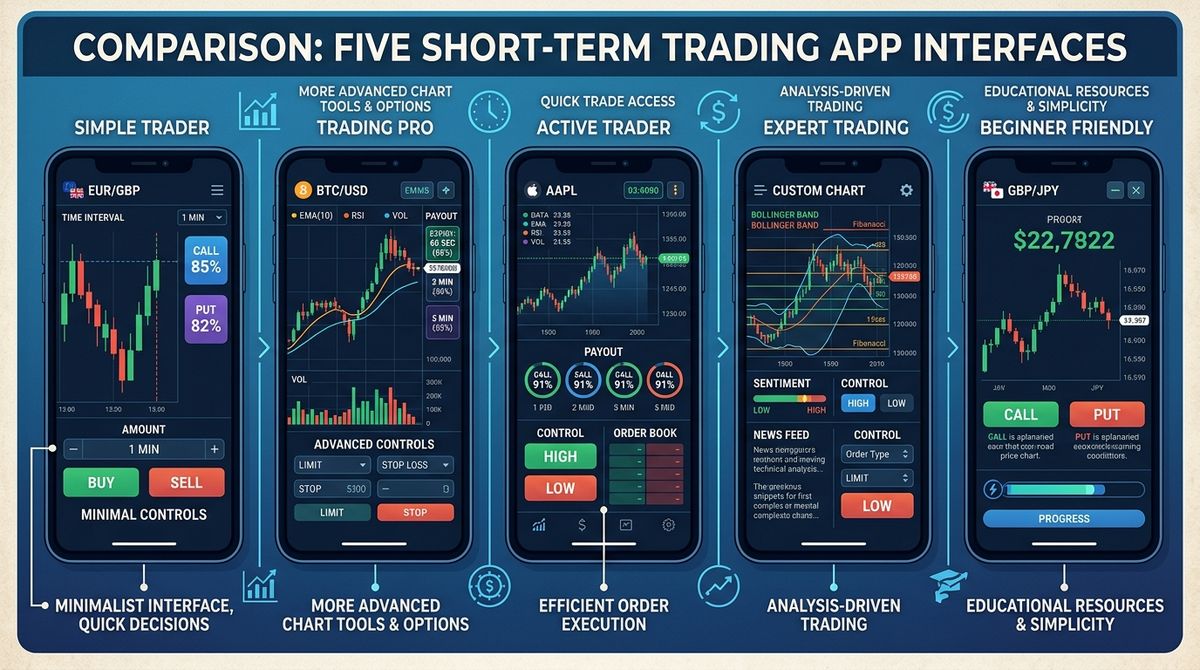
Quotex’s web and mobile interface is clean. 29 indicators, sub-1-second execution in testing, and no clutter. That’s the strength. The limitation is the same thing: no MT4, no MT5, no TradingView, no economic calendar, no real research depth. Deriv pulls ahead here with TradingView integration and MT5 web access. Pocket Option offers MT4/MT5 plus social trading. If you want chart-driven discretionary trading with serious tooling, Quotex isn’t built for that. If you want to tap up or down on a one-minute candle, it’s faster than anything else in the category. The mobile experience holds up too, which matters since most short-duration trading happens on phones.
Asset Range and Contract Variety
One independent test [see the asset breakdown] counts 95+ binary instruments and over 400 instruments overall, with expiries from 5 seconds to 4 hours. That’s a wider menu than Binarium or ExpertOption but narrower than Deriv, which adds multipliers, accumulators, derived indices, and longer-duration contracts. Quotex doesn’t offer CFDs, ladder options, futures, or exotic event-based markets. The full list of tradable markets is solid for short-term binary speculation, weak for anyone wanting diversified exposure.
Regulation & Safety
Regulation, Safety, and Trust
This is where the comparison stops being about features.
The Service Agreement[1] names ON SPOT LLC GROUP in St. Kitts and Nevis; the current About page[2] uses ON SPOT GROUP LLC. Its IFMRRC registration expired in 2021, and IFMRRC was never a government regulator anyway. Spain’s CNMV, Portugal’s CMVM, and Poland’s KNF published notices naming particular Quotex-linked entities or domains in their jurisdictions. DayTrading.com rates regulation 1.5/5. FXScouts rates it 0/5 for regulation and labels the broker “High risk, avoid.”
Traders Union publishes a high overall score, but the number changes, which sounds contradictory because an overall rating and a regulation rating answer different questions. Both can be true: Quotex works well as a product and offers almost no safety net if something goes wrong. I take the regulatory concerns seriously, and the question of whether Quotex is actually legit deserves a direct answer rather than a vague “it depends.”
The more useful comparison most reviews dodge: Quotex versus regulated CFD brokers like Pepperstone, IG, or XM. Depending on the broker, legal entity, and your country, that can mean materially stronger protections.
Payments & Fees
Deposits, Withdrawals, and Hidden Fees
Withdrawal speed depends on tier. Pro and VIP accounts often see funds in 24 hours, Standard in 48. The FAQ[3] describes an average of 1–5 days; the Payment Policy §4.8[4] gives up to 7 days for a withdrawal decision, or 14 in certain circumstances. There are no trading commissions, and Quotex says it generally charges no deposit fee, although payment-provider fees may apply, but a 180-day inactivity fee applies at 1% of balance per day with a $1 minimum, which can quietly drain a dormant account. Pocket Option charges 0.05% on Perfect Money transactions for context. The mechanics of getting money out cleanly deserve attention before your first deposit, and account verification needs to be completed early to avoid withdrawal holds later.
Bonuses & Demo Accounts
Bonuses, Demo Accounts, and Beginner Resources
The demo account is genuinely useful: a reloadable $10,000 virtual balance[5], market data, no stated time limit. That is generous, though demo limits at other brokers vary. The practice environment works well for strategy testing before risking real money. Daily trading signals come built into the platform, which beginners often find helpful and experienced traders mostly ignore.
Bonuses are where I get skeptical. Deposit bonuses, cashback, and risk-free trades sound attractive, but the terms attached to promotional credits typically include turnover requirements for bonus-derived profits; the bonus rules[6] do not make the bonus itself withdrawable cash. Education is thin: no live webinars, no economic calendar, no real research reports.
Which Broker Fits?
When to Choose Quotex vs When to Pick a Competitor
Choose Quotex if: you want short-duration binary trades, sub-second execution, a $10 entry point, a clean interface, and you understand you’re using an offshore broker with no investor protection. Keep balances small. Withdraw often.
Choose Deriv if: you want broader product variety, MT5 access, TradingView charts, and a regulatory position you have checked for your country and the product you plan to trade.
Choose Pocket Option if: you want MT4/MT5 integration, social trading, and AI tools alongside binaries.
Consider Capitalcore only after checking its current product and U.S. status: it says U.S. clients are welcome, but that is not proof of U.S. regulatory authorisation or binary-options availability. Quotex blocks U.S. accounts entirely. The U.S. accessibility question comes up constantly and the answer is straightforward.
Choose a regulated CFD broker if: you have verified its licence and your local protections matter more than 98% payout headlines.
Final Verdict
The Verdict: Where Quotex Stands in 2026
Quotex is a strong product and a weak custodian. The platform is fast, the payouts are competitive when conditions cooperate, and the minimum deposit makes it easy to test. But the regulatory profile is genuinely bad, and the gap between advertised and realized payouts is wider than the marketing suggests. The broker’s overall fee and risk profile is worth reading in detail, along with the issues most reviews glaze over.
If you trade with Quotex, treat it as speculation capital, not savings. Enable 2FA. Withdraw regularly instead of letting a balance build up. Test responsiveness of the support team before you need them, not after. And verify any broker against your national regulator’s register before funding, because that step costs nothing and rules out most of the worst outcomes.
Quotex earns its spot in 2026 comparison tables. It does not earn blind trust.