Binary options brokers all look the same from the outside: pick an asset, predict a direction, win or lose. What separates a usable platform from a gambling app is what sits underneath that interface. After spending real time inside the platform, reading every review I could find, and stress-testing the demo, here is exactly how Pocket Option works, and what a first-time trader needs to understand before sending money.
How It Works
What Pocket Option Is and How It Works
Pocket Option is a binary-options trading platform: I select an asset, choose how long the trade should run, enter a stake, and predict whether the price will close higher or lower than its current level at expiry. If my forecast is correct, the platform credits my stake plus a fixed payout percentage. If it is wrong, the stake is gone. There is no asset ownership, no margin call, no partial profit. It settles all-or-nothing.
That mechanic is the whole product. Everything else (charts, indicators, AI tools, tournaments, copy trading) is built around that single binary decision. What I found in my research is that most walkthroughs spend ages explaining the buttons and almost no time explaining the math: a 92% payout still produces negative expected value unless I have a measurable win-rate edge above roughly 52.08%. That is the single most important thing a first-time trader needs to internalize before placing a real trade.
Getting Started
Getting Started and Using the Trading Interface
The First-Time Trader’s Path: From Signup to First Trade
The onboarding sequence is short. I create a free account with an email and password, confirm the email, and land in the trading cabinet. From there I can either jump straight into the demo environment or start the verification and deposit flow for a live account. Pocket Option’s own quick-start page even offers a one-click demo entry that skips the signup form entirely.
The order I recommend is rigid: register, practice on demo, verify identity, then deposit. Skipping the demo to chase a deposit bonus is the most common first-time mistake I see in forums and YouTube comments.
Demo Account First, Real Money Second
The demo account is non-negotiable. The demo account loads with $50,000 in virtual funds — this is the confirmed starting balance. Some older tutorials cite lower amounts, but the current platform provides $50,000 reloadable on demand. I treat the demo as a measurement tool, not entertainment. If I cannot produce a positive win rate across 50 to 100 demo trades using a defined setup, I have no business risking real capital.
The demo balance resets on demand, which is useful when I want to test a new strategy from scratch without psychological baggage from previous virtual losses.
Account Verification and Regional Access
Pocket Option’s AML policy[1] says KYC is not mandatory unless requested, although bank transfers require full name-and-address verification. When asked, I upload a government-issued ID (passport, driver’s license, or national ID) plus proof of address. One video walkthrough puts processing at around 24 hours, sometimes same-day during business hours. The verification page on the platform handles document uploads directly, and I’d budget a full business day before assuming anything is wrong. For a deeper breakdown of the document requirements and common delays, see my guide on getting through KYC without holdups.
Access is the bigger gate. Pocket Option’s own terms state the service is not available to residents of the EEA, USA, UK, Israel, Japan, Philippines, and Brazil. WikiFX confirms similar restrictions. Confirming eligibility before depositing is non-negotiable, because a blocked account after funding becomes a withdrawal headache, not a trading one.
Inside the Trading Interface
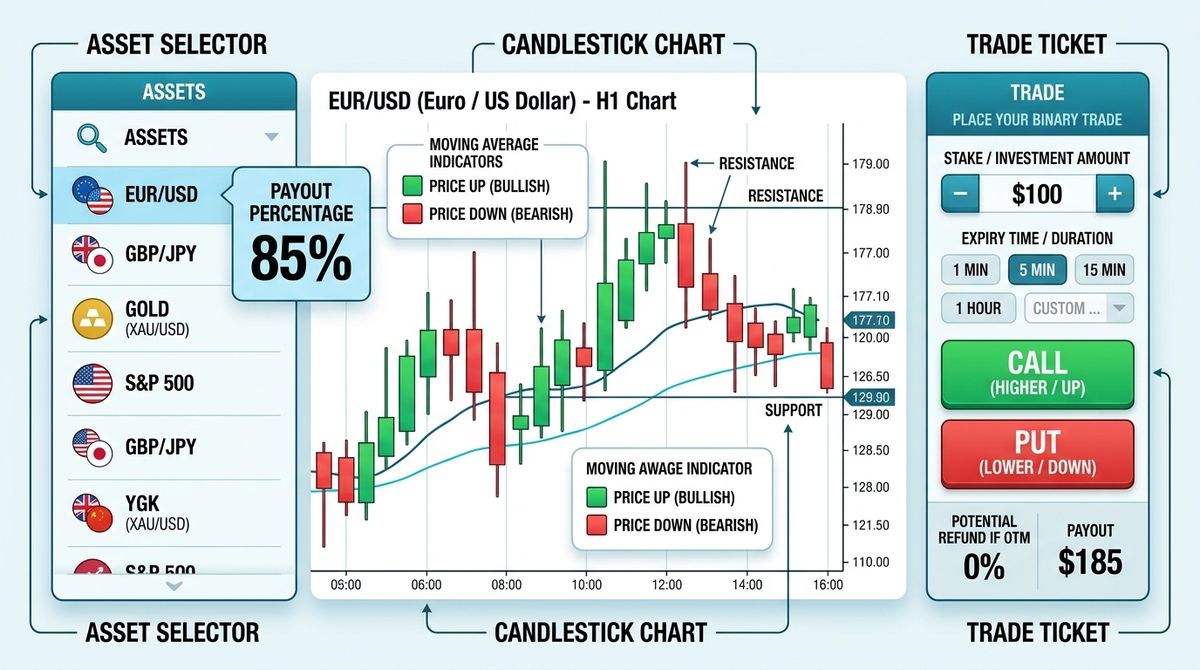
The cabinet is built for speed, not depth. On the left sits the asset selector with categories for currencies, cryptocurrencies, commodities, stocks, indices, and OTC markets. The center holds the chart, with controls for chart type (candles, Heikin Ashi, line, area, bars) and a timeframe dropdown. The right panel is the trade ticket: stake amount, expiry time, and two large buttons for the directional call.
The first thing I click is the indicator menu, because trading without one is guesswork. The second is the payout percentage display, which sits next to the asset name and changes by instrument and time of day.
Choosing an Asset and Setting Expiry
BinaryOptions.net reports 180+ binary assets across five markets, with expiry times reported from 3 seconds to 4 hours in its current review. That range is unusually wide. Most traditional binary brokers cap minimum expiry at 30 or 60 seconds.
For a first-time trader, I would ignore everything under 1 minute. Sub-minute trades are pure noise: spreads, latency, and price flicker destroy any technical edge. I’d start with 1-minute or 5-minute expiries on a major forex pair (EUR/USD or GBP/USD) during the London or New York session, when liquidity is highest and OTC quirks are least relevant.
Placing a Call or Put Trade
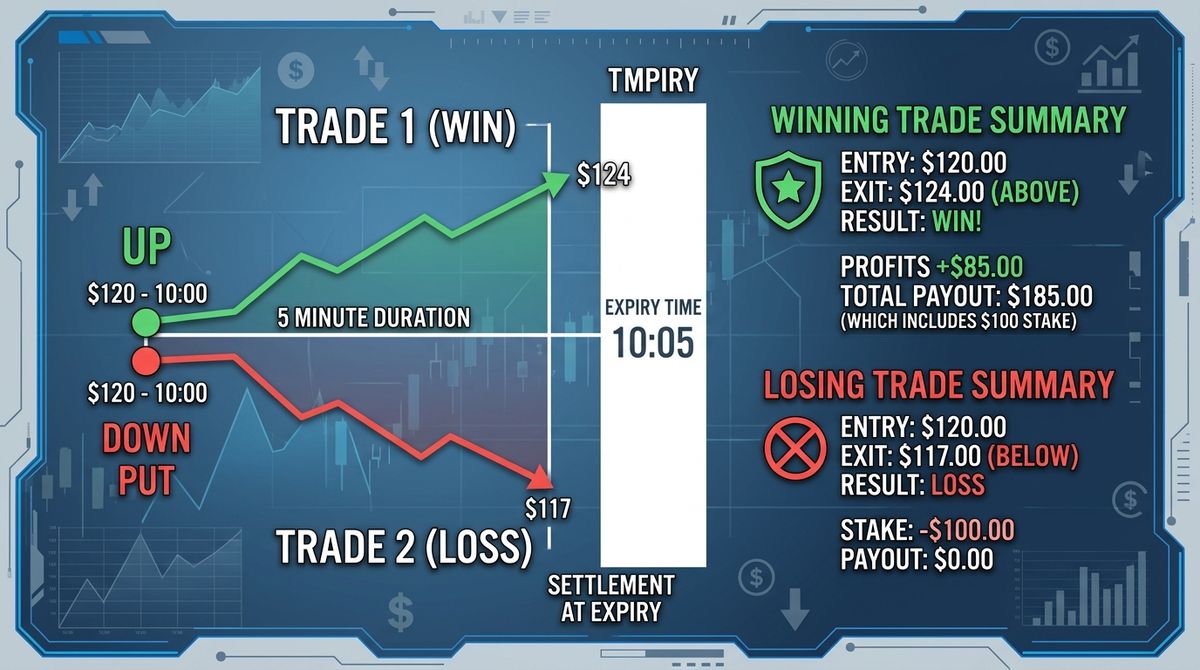
The order flow is four clicks. Select the asset. Set the stake amount (the minimum trade size is effectively $1). Set the expiry. Click “Buy” if I expect the price to rise by expiry, “Sell” if I expect it to fall. Concretely: a $5 stake on EUR/USD with a 1-minute expiry and an 85% displayed payout. If EUR/USD closes higher than the entry price after 60 seconds, I receive $9.25 total ($5 stake + $4.25 profit). If it closes lower, I get $0; if it closes at exactly the same price, Pocket Option’s Public Offer[2] says the stake is returned.
The “at exactly the same price” case is rare but real. Pocket Option’s published rule returns the stake on an equal close, so I treat ties as refunds rather than losses.
Payouts & Payments
Payouts, Settlement, Deposits, and Withdrawals
How Payouts and Settlement Actually Work
Settlement is binary and instant at expiry. The platform compares the closing price against the entry price. Above entry settles a “Buy” as a win; below settles a “Sell” as a win. The displayed payout percentage at the moment of entry is the rate that applies, not the rate that may show 30 seconds later.
Payout percentages are source-dependent. Scribd cites successful forecasts paying up to 92%. BinaryOptions.net reports peak payouts of 92% on forex, crypto, and stocks, with Express Trades reaching 218% on chained predictions. Pocket Option’s marketing materials advertise payouts up to 218% on its quick trading pages, but those are self-reported ceilings. Live testing showed off-peak payouts often run 2% to 12% lower than the headline number.
| Trade type | Typical payout range | Best for |
|---|---|---|
| Standard binary (forex majors) | 70% to 92% | Beginners during major sessions |
| OTC markets (weekends) | 80% to 92% | Avoid as a beginner |
| Express Trades (chained) | Up to 218% | Experienced traders only |
| Crypto and indices | 70% to 88% | Confirmed-trend setups |
A Worked Example
Here is the math that walkthroughs gloss over. I place ten $10 trades at an 85% displayed payout with a 50% win rate. Five wins produce 5 × $18.50 = $92.50. Five losses produce $0. Total return: $92.50 on $100 staked. Net: a $7.50 loss.
To break even at 85% payout, I need to win 54.05% of trades. At 92%, I need 52.08%. At 70%, I need 58.82%. Without a strategy that produces a measurable edge above those thresholds across hundreds of trades, the platform extracts money over time. This is the single calculation every first-time trader should run before depositing.
Funding the Account: Deposits and Withdrawals
Pocket Option supports cards (Visa, MasterCard), e-wallets, bank transfers, regional methods like Pix and Fasapay, and a wide range of cryptocurrencies. The broker advertises no deposit or withdrawal fees on its side, though payment processors and crypto networks add their own.
The minimum deposit is $5, though this varies by payment method and region — some methods require $10 or more. Plan around $5–$10 as the practical floor depending on how you fund the account. The $5 minimum typically applies to crypto and certain e-wallets; cards may require $10. For a method-by-method breakdown including processing times and regional availability, see the full deposit options guide.
Withdrawals route back to the original deposit method when possible, with a $10 minimum per BinaryOptions.net. Pocket Option’s payment policy[3] allows up to five business days for the broker to process a withdrawal; arrival after that also depends on the provider. Verification must be complete before the first withdrawal, and bonus-locked funds carry turnover requirements. If a withdrawal stalls, the most common causes and fixes are usually documentation or bonus-related, not platform refusal.
Trading Tools
Tools That Help First-Time Traders Make Better Decisions
The difference between gambling and informed speculation is whether I have a repeatable reason for each entry. Pocket Option’s analysis tools exist to provide that reason; whether I use them is the variable.
Charting and Indicators
The indicator library covers the standards: MACD, RSI, Moving Averages, Bollinger Bands, Stochastic, Awesome Oscillator, and dozens more. Chart types include candles, Heikin Ashi, area, line, and bars. I can run multi-chart layouts and drawing tools (trendlines, Fibonacci, channels) directly in-browser.
YouTube strategy videos show traders combining a moving average crossover with MACD confirmation on Heikin Ashi candles for 1-minute trades. Another setup uses support and resistance zones on the 1-minute chart with 5-second confirmation candles before entry. These are anecdotal demonstrations, not validated systems. The principle they share is what matters: never enter a trade without at least one indicator confirming the directional bias.
AI Trading, Social Trading, and Tournaments
Pocket Option has added several features beyond standard binary trading:
- AI Trading: a one-click tool that analyzes real-time price action, RSI, MACD, Bollinger Bands, and historical patterns, then suggests trade entries with automated direction and expiration recommendations
- Social trading: lets me view and copy other traders’ positions
- Tournaments: gamified competitions with cash prizes, typically running on demo or low-stake live accounts
- Achievements and Gems: a loyalty layer unlocking Bronze, Silver, and Gold perks like risk-free trades and cashback
- Express Trades: chained directional predictions with payouts up to 218%
FintechNews Africa describes the AI feature as using probability scoring with thresholds (it issues a “BUY” signal only when profit likelihood exceeds, for example, 64%) and volatility filters as safeguards. That article is promotional, not an independent audit. BinaryOptions.net is more measured, noting that Pocket Option does not clearly explain the AI’s mechanics. I treat AI Trading as an experimental layer to test on demo, not a profit engine. No automated tool removes the negative expected value problem; it just changes who is making the directional call.
Risks & Trading Rules
Regulation, Practical Risk Rules, and Common Misconceptions
Is Pocket Option Legitimate? Regulation and Risk
Pocket Option carries no top-tier financial regulation and has received warnings from the FCA, CFTC, and other national authorities. The platform mechanics work, but legal recourse if something goes wrong is extremely limited. The full picture — entity history, license status, regulator actions, and withdrawal complaint patterns — is covered in the Pocket Option Review.
Practical Rules I’d Follow as a First-Time Trader
These are the non-negotiables I’d put on a sticky note next to the monitor:
- Spend at least 50 demo trades on one strategy before depositing anything
- Never risk more than 2% of the account balance on a single trade
- Confirm every entry with at least one indicator, never trade on impulse
- Avoid OTC markets and sub-minute expiries for the first 90 days
- Treat advertised payout percentages as ceilings, not averages
- Verify regional access and complete KYC before depositing
- Never chase losses by doubling stake size, that is how accounts vanish in an afternoon
- Withdraw small profits early to test the cashout process before scaling deposits
Common Misconceptions About How Pocket Option Works
It is a stock broker. It is not. I never own the underlying asset. A “Buy” on Apple is a directional bet on the price for a fixed duration, not a share purchase.
Payouts are guaranteed. They are not. Displayed payout percentages can shift between sessions and assets, and the all-or-nothing structure means a wrong call returns zero regardless of how close the price came to my forecast.
AI Trading ensures profits. It does not. Probability scoring and volatility filters improve signal quality compared to random entries, but they do not produce positive expected value on their own.
A low minimum deposit signals low risk. It does not. A $1 minimum means I can lose $1 quickly, then $10, then $100. The all-or-nothing structure scales risk with stake size, not with deposit floor.
Bonuses are free money. They are not. The 50% and 100% deposit bonuses commonly advertised can carry offer-specific turnover requirements before bonus funds and bonus-linked profits can be withdrawn; the broker uses 50 times the bonus amount as one example. The mechanics of what these bonuses actually cost are worth understanding in the breakdown of bonus terms and traps.
FAQs
Frequently Asked Questions
How much money do I need to start on Pocket Option?
Minimums range from $5 to $10 depending on the method and region. I recommend starting with an amount I can afford to lose entirely, typically $50 to $100, and only after running at least 50 demo trades.
How long does a single trade take?
Recent reviews report expiry times from 3 seconds to 4 hours. For first-time traders, I’d stick to 1-minute, 5-minute, or 15-minute expiries on major forex pairs. Anything under a minute is noise; anything over a day requires fundamental analysis most beginners are not equipped for.
Can I lose more than my stake?
No. Binary options have fixed risk by design. Maximum loss equals the stake. There are no margin calls, no negative balances, and no leverage-driven liquidations. The trade-off is the all-or-nothing structure: a wrong call loses 100% of the stake, even if the price moved only one pip in the wrong direction.
Is Pocket Option safe for beginners?
The platform is functionally safe in that fixed-risk binary options cannot drain me beyond my stake. The regulatory environment is not safe, given the absence of valid financial licensing. For demo practice and learning, it is workable. For meaningful capital, a regulated alternative is the right answer.
How do I withdraw my profits?
I open the profile menu, select the withdrawal section, choose the method (typically the same one used to deposit), and submit the request. Minimums start at $10. The broker’s stated processing window is up to five business days, and the provider may take longer to deliver the funds. KYC must be complete when requested, and bonus-linked funds may remain restricted until the applicable turnover requirement is met or the bonus is canceled. If a withdrawal is delayed beyond the published window, I check documentation and bonus terms first, without assuming they explain every delay.
Does the platform actually work as advertised?
The trade execution and settlement mechanics work as advertised. The chart, indicators, and demo are functional and accurate. The friction points are the gap between advertised and realized payouts (often 2% to 12% off-peak), the bonus turnover requirements, and the unregulated status. For a full breakdown of where the platform delivers and where it falls short, the full platform review covers each in detail.
Next Steps
What Changes Once This Clicks
Understanding how Pocket Option works is not the same as understanding whether to use it. The mechanics are straightforward: pick a direction, stake an amount, win a fixed payout or lose the stake. The math is brutal: without a strategy that produces a win rate above 52% to 58% (depending on payout), the platform is a slow drain. The regulatory reality is sober: no valid license, limited recourse, restricted regions.
Once those three things click together, the question stops being “how does it work” and becomes “do I have an edge that justifies the risk.” That is the only question that matters, and the demo account is where I answer it before a single dollar of real capital ever touches the platform.