Risk and regulatory notice: Binary options are high-risk, all-or-nothing products and may be prohibited or restricted for retail customers where you live. You can lose the full amount committed to a trade. Verify the legal entity and its authorisation in an official regulator register before sending money or identity documents. This page is general information, not personal financial advice.
Quotex does not work in the USA. Not as a live platform for U.S. residents under Quotex’s own terms. The Service Agreement §4.2.2[1] excludes U.S. residents; The published materials do not identify current U.S. regulatory approval for this operator. A signup screen loading is not proof of eligibility, and legal remedies depend on the case. Below I break down what that means in practice, why the restriction exists, and what risks someone takes by trying to work around it.
US Access
Does Quotex Accept US Traders?
No. Quotex does not accept signups from U.S. residents, and the platform’s terms §4.2.2[1] exclude U.S. residents. Citizenship alone is not the test stated there.
That means a U.S. resident should not open or fund a live account under those terms. An existing account or dispute needs case-specific handling; the terms do not erase a support pathway or every legal option. The site may load in a browser, but loading is not the same as access. The rest of this article explains why the restriction exists, what happens if someone tries to bypass it, and what American traders should do instead.
US Restrictions
Why Quotex Is Restricted in the United States
The reason is regulatory. Quotex’s current About page[2] names ON SPOT GROUP LLC in St. Kitts and Nevis. Historical warnings name other entities or domains; I do not treat them as proof of the same present operator. It holds no Tier-1 license: no SEC, CFTC, FCA, ASIC, or CySEC registration. The cited IFMRRC claim needs a dated direct record before I would rely on it.
For U.S. retail customers, binary options are available through regulated U.S. venues under applicable rules. The CFTC explains the exchange framework. Offshore platforms offering binary options to U.S. residents fall outside that framework, which helps explain why Quotex excludes U.S. residents. The CFTC and SEC warn about fraud involving online binary-options platforms; they do not say all binary options are banned on U.S. exchanges.
Countries Where Quotex Is Also Restricted
The U.S. is not alone. The current Service Agreement §4.2.2[1] also excludes Canada, the United Kingdom, EEA countries, Hong Kong and Russia, among others; its list does not include Indonesia. Regulators in multiple jurisdictions have issued formal warnings against Quotex-linked entities, including Spain’s CNMV, Portugal’s CMVM, Poland’s KNF, and Italy’s CONSOB. The separate Indonesia/BAPPEBTI claim needs a dated primary notice before I would use it here. This is a consistent pattern, not a U.S. quirk.
Access Attempts
What Happens If You Try to Access Quotex From the US
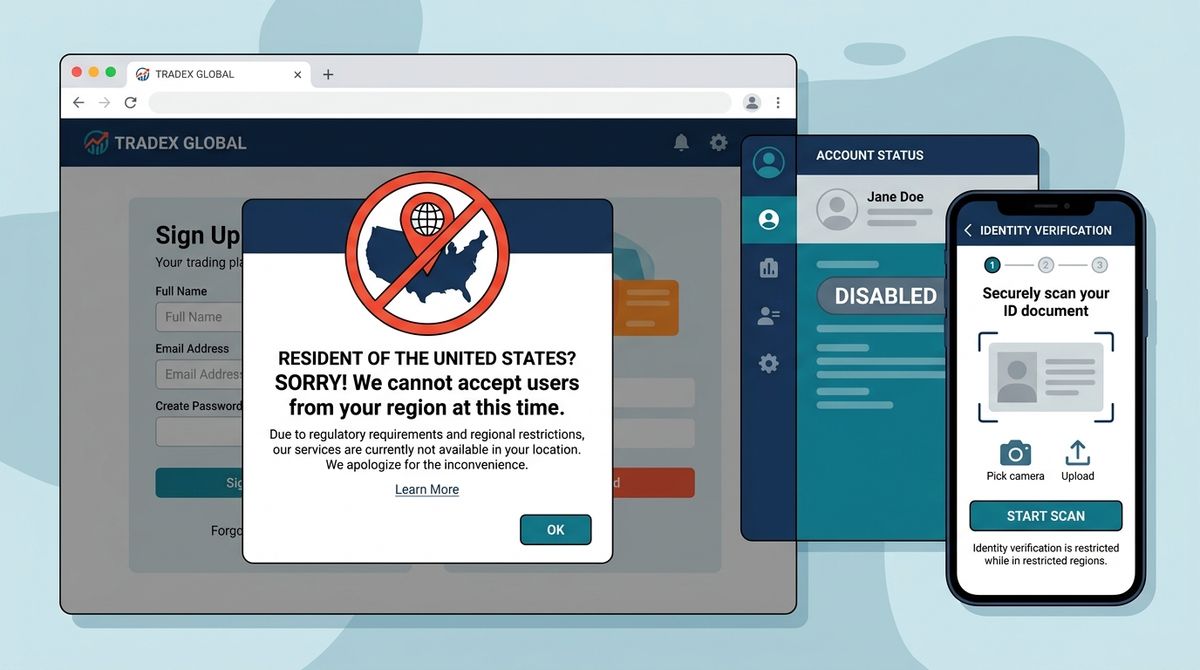
The terms exclude U.S. residents, but the current signup flow may use IP, device data or KYC differently by case. A VPN would not change the residence condition in the agreement. If a user’s documents show U.S. residency, the account may face eligibility review.
VPN workarounds are not a loophole. A VPN does not make a U.S. resident eligible under the published terms[1]. Some users allege account freezes or withdrawal difficulties, but their accounts are unverified observations, not proof that a fixed sequence happens to everyone.
If withdrawal protection matters at all, accessing Quotex from the U.S. is a losing proposition before the first trade. For a broader look at the warning signs most reviews skip past, my breakdown of the issues no one talks about covers what to watch for.
Offshore Risks
Risks of Using Offshore Binary Options Platforms
The exclusion is consistent with the U.S. regulatory framework. A U.S.-regulated venue offers oversight and complaint channels that Quotex does not identify for U.S. residents. That does not prove a customer has no contractual, payment-provider or legal options in every dispute.
The documented issues are real. Quotex’s FAQ[3] gives a 1-to-5-day withdrawal average, not a five-business-day payment deadline. The Service Agreement §7.27[1] allows a 1% daily maintenance fee on the current balance, minimum $1, after 180 days without account operations. I would date and link any WikiFX safety score before relying on it.
| Risk Factor | Quotex | CFTC-Regulated Broker |
|---|---|---|
| U.S. regulatory oversight | None | Yes |
| Investor compensation | None | Depends on venue and product |
| Dispute resolution | Contract terms; other remedies vary | Regulatory complaint channels; remedies vary |
| Fund segregation guarantee | Not verified | Depends on venue and customer-funds rules |
| Legal recourse for U.S. residents | Not determined case by case | Depends on facts and jurisdiction |
Binary options are structurally high risk regardless of platform. They are fixed-return, all-or-nothing contracts where the entire stake can be lost on a losing contract. Add an unregulated offshore counterparty and the risk compounds.
US Alternatives
Regulated Alternatives for US Traders
Americans interested in binary options can look at U.S.-regulated venues, including the Nadex designated contract market, which also does business under the Crypto.com name. The current CFTC register is the place to verify venues; available products and customer eligibility change. Traditional options are a different product.
Before depositing anywhere, check the relevant exchange and intermediary status in the CFTC register and NFA BASIC; for securities offerings, check SEC EDGAR where applicable. If you cannot verify the relevant authorization, do not fund the account. For a side-by-side look at how Quotex stacks up against competing platforms, my comparison of Quotex and similar brokers lays out the differences, and the broader question of whether the platform is trustworthy at all is worth reading before any signup attempt anywhere.
FAQs
Frequently Asked Questions
Can I use a VPN to access Quotex from the USA?
A VPN may change what loads in a browser, but it does not change the terms excluding U.S. residents[1]. A VPN is not proof that an account will pass KYC; nor does every U.S. document necessarily trigger closure. Do not use one to misstate your residence.
Is Quotex legal for US citizens traveling abroad?
The published exclusion is based on U.S. residency, not citizenship alone. A U.S. citizen living elsewhere must check both the current terms[1] and the laws that apply to them; approval is not guaranteed.
Does Quotex offer a demo account to US users?
The site advertises a $10,000 virtual demo without registration[4]. That does not make live trading available to U.S. residents, and demo access may also vary by location.
What about Quotex bonuses or promotions for US users?
Not accessible. U.S. residents cannot register, so promotional offers, deposit matches, and the platform’s bonus programs do not apply.
Are there any U.S.-regulated binary options brokers?
Yes. The CFTC describes regulated U.S. venues, including Nadex and CME in its binary-options advisory. Check the current DCM register and each venue’s live product list before choosing one; oversight does not eliminate trading risk.
What should I do if I already deposited funds from the US?
Save the transaction records and contact Quotex support. If you suspect fraud or an unauthorized charge, ask your payment provider what dispute options apply to that method, and consider a CFTC report or IC3 report where appropriate. Recovery is uncertain, so document the facts before taking a step.
What It Means
What This Means for American Traders
The bottom line is the distinction I opened with: technical access and legal access are not the same thing. A site that loads in a browser is not proof that a U.S. resident is eligible to trade. Under Quotex’s published terms, that resident is excluded. A technical workaround provides no regulatory protection or guaranteed withdrawal rights. The smarter play is sticking with brokers the CFTC and SEC actually supervise. The protections are not theoretical. They are the entire reason regulators exist.