A polished interface is not a safety net. That is the trap with Pocket Option: it looks like a modern broker, behaves like a modern broker, and markets itself like a modern broker, but the question of whether it is actually safe to hold real money there is a different question entirely. I’m going to walk through exactly what I check before I trust any broker, and where Pocket Option lands on each of those checks.
Safety Overview
Pocket Option Safety Overview and Platform Background
The Short Answer: Is Pocket Option Safe?
No. By the standards I apply to any broker that holds my money, Pocket Option is not safe. There is no top-tier regulator standing behind it, multiple national authorities have published official warnings against it, and the public complaint record is dominated by withdrawal disputes, account freezes, and KYC blocks that surface right after a trader books a meaningful profit.
That verdict is not about whether the platform loads, whether trades execute, or whether the demo account is fun to use. The platform works. The safety net does not exist. Three questions decide whether I trust a broker: is the operating company real and traceable, is it regulated by someone with enforcement power, and does it reliably pay withdrawals. Pocket Option passes the first, fails the second outright, and is sharply contested on the third.
What Pocket Option Actually Is
Pocket Option is a binary options broker launched in 2017. It offers 100+ to 180+ tradable assets across forex, crypto, commodities, stocks, and indices, with expiries reported from 3 seconds to 4 hours in recent reviews. The minimum deposit is $5, the minimum withdrawal is $10, and the demo account loads with up to $50,000 in virtual funds. It supports social and copy trading, runs a mobile app, and accepts a heavy mix of crypto and local payment gateways.
The operating company has changed names and jurisdictions more than once. Broker materials have identified Infinite Trade LLC as an operator, registered in Costa Rica (registration 4062001303240), as stated in the broker’s company information[1]. The brand has previously operated under different corporate names — Gembell Limited in the Marshall Islands being an earlier iteration. The pattern of transferring the legal entity to a new shell company while keeping the brand unchanged is consistent across these changes and is something serious due diligence flags immediately. A MISA licence claim for Infinite Trade LLC (T2023322) is described as suspended in third-party reviews, but I could not confirm its current status on the authentic MISA register. New Zealand’s FMA says MISA lacks authority to licence financial institutions in the Comoros.
In other words, the company exists, it is traceable on paper, and it has a real corporate trail. But that trail has moved across offshore jurisdictions repeatedly, which matters because each move resets the regulatory clock and tends to land in a place with weaker enforcement than the last.
Regulation & Warnings
Regulation and Official Warnings
The Regulation Problem (The First Thing I Check)
Regulation is the single most important safety filter for any broker, and it is the one Pocket Option fails hardest. Top-tier oversight from bodies such as the FCA in the UK, the CFTC in the US or ASIC in Australia can bring enforceable safeguards. Client-money segregation, compensation and dispute routes depend on the jurisdiction, firm and product; they are not identical or automatic. ESMA coordinates EU securities rules but does not itself licence individual brokers.
I found no top-tier authorisation for Pocket Option that would give me those protections through this operator. Anyone who deals with the firm under the FCA warning will not have access to the Financial Ombudsman Service or the Financial Services Compensation Scheme, which means if the firm refuses to pay or disappears, those UK ombudsman and compensation protections are unavailable; other remedies, if any, depend on the facts and jurisdiction.
Where Pocket Option Is Registered
The corporate address has moved across several offshore jurisdictions over the years. The FCA’s unauthorised firm notice lists a Saint Lucia address (C/O LC02 503, Choc Bay, Castries). Costa Rica is the current registration country for Infinite Trade LLC (reg. 4062001303240). Earlier filings traced to the Marshall Islands under Gembell Limited. The claimed Mwali/Comoros licence’s current status could not be independently confirmed on the authentic register.
A jurisdiction that keeps moving is a red flag on its own. Legitimate brokers anchor themselves in one or two well-regulated countries and stay there. A trail across the Marshall Islands, Saint Lucia, Costa Rica, and the Comoros is the opposite pattern.
The IFMRRC Claim
The broker has historically referenced the International Financial Market Relations Regulation Center (IFMRRC) as a form of regulatory oversight. The IFMRRC is not a government regulator. It has no governmental statutory authority or statutory compensation scheme, and no public enforcement power against the firms that “register” with it. In a Trustpilot complaint on a Pocket Broker page, a trader said IFMRRC replied that Pocket Option was not regulated by it; I have not seen that correspondence and cannot verify the identity link to today’s operator.
Treating IFMRRC, or an unverified MISA licence claim, as equivalent to top-tier oversight would mislead me. Neither is equivalent to FCA, CFTC, ASIC, or ESMA oversight, and I would not let either appear on a safety checklist as a tick.
Official Warnings From Financial Regulators
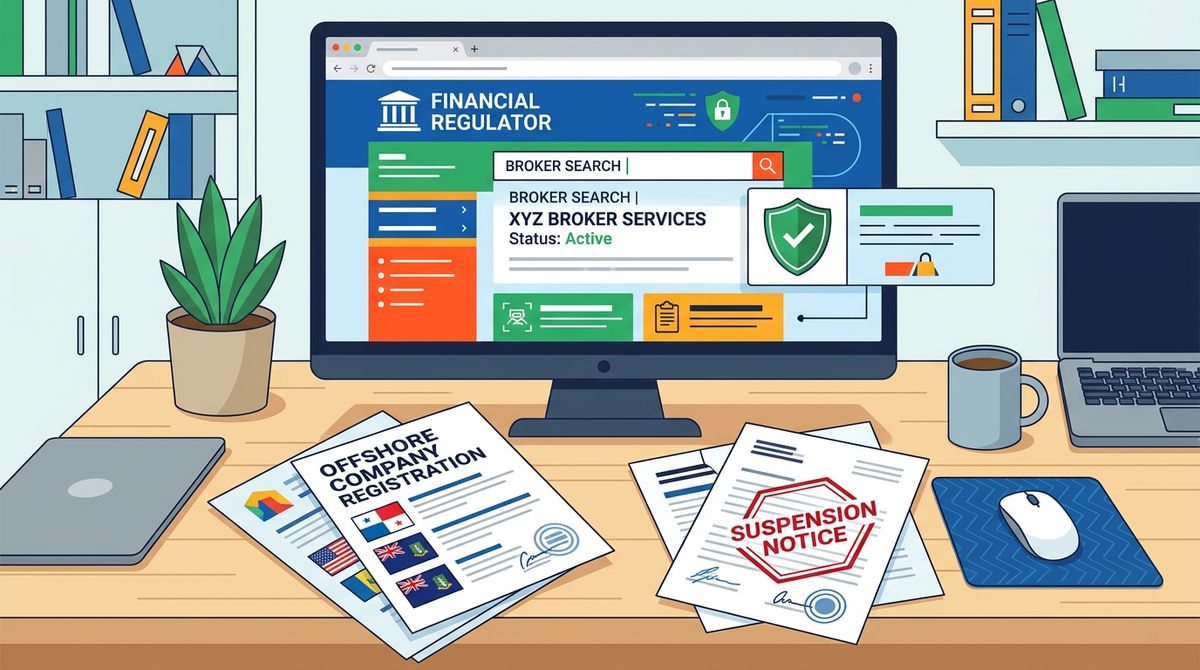
This is where the evidence stacks up beyond dispute. Multiple national regulators have publicly flagged Pocket Option:
| Regulator | Country | Action |
|---|---|---|
| FCA | United Kingdom | Unauthorised firm warning, Saint Lucia address |
| CFTC | United States | Added to RED List on July 6, 2022; not a legal finding of violation |
| Alberta Securities Commission | Canada | Not registered to trade or advise in Alberta |
| CVM | Brazil | 2025 warning naming Infinite Trade LLC and pocketoption.com |
| Consob | Italy | Blocked PO Trade Ltd’s named p.finance sites and requested removal of its linked Pocket Option Android app, Feb 2026 |
| FSMA | Belgium | Listed by FSMA |
| Securities Authority (ISA) | Israel | 2025 warning naming pocketoption.com |
The CFTC’s RED List entry is particularly worth understanding. It says Pocket Option appeared to solicit U.S. customers from outside the country without required registration, but explicitly says listing is not a finding that a legal violation occurred.
Pocket Option does not provide service to residents of the EEA, USA, UK, Israel, Japan, Philippines, and Brazil. That restriction list matters even for traders outside those regions, because it tells me which regulators were credible enough threats that the broker chose to formally exit rather than comply.
Complaints & Reviews
Withdrawal Complaints and Review Reliability
Withdrawal Complaints: The Pattern I Keep Seeing
Regulation tells me what happens if something goes wrong. Withdrawal complaints tell me how often things actually do go wrong. Across Trustpilot, Reddit, WikiFX, and Forex Peace Army, the pattern is consistent. (These are individual experiences, not verified facts, and review platforms have well-documented issues with both incentivized positive reviews and unverifiable negative ones. The signal is in the pattern across multiple independent posts, not any single complaint.)
The “Win-Then-Lock” Pattern
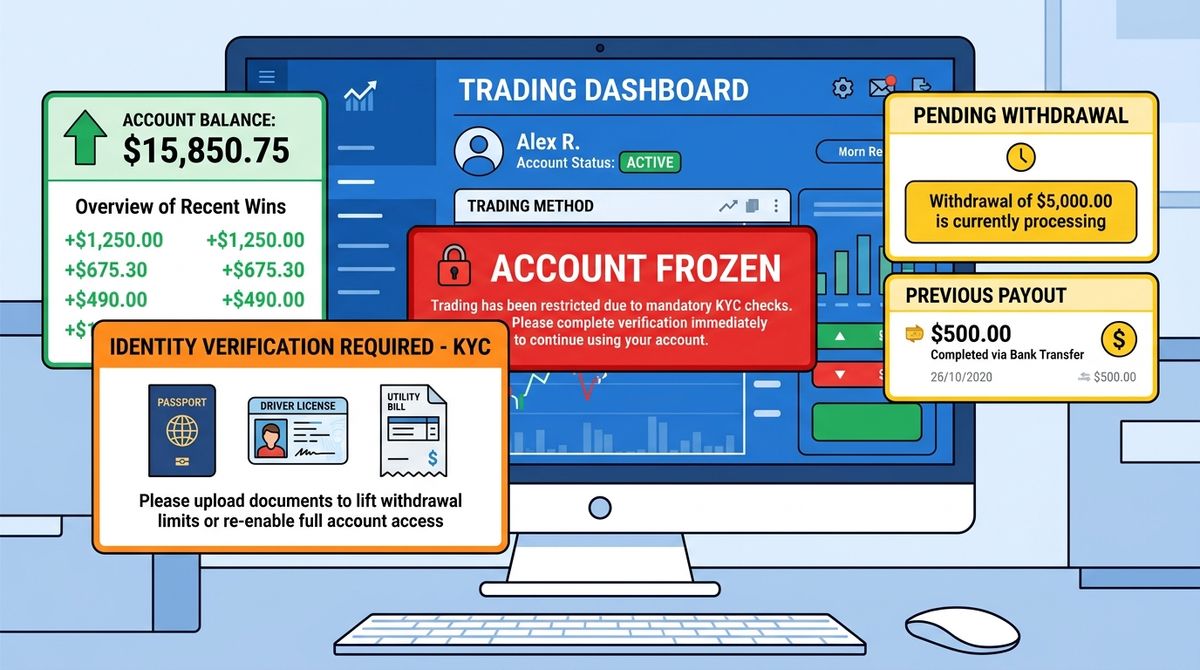
The most common reported tactic: a small initial withdrawal goes through cleanly, which builds trust and encourages larger deposits. Then, once profits cross some threshold, the account is locked or the withdrawal is frozen. One reported case described a $69 withdrawal approved followed by the remaining $270 being held. Another described a $600 deposit growing to a $1,400 balance, at which point withdrawal problems began.
WikiFX exposure reports include allegations of withheld balances in the range of tens of thousands of dollars, alongside frozen accounts, blocked logins, and uncredited deposits. These are individual, unverified user claims.
KYC and Clause 2.2 Account Blocks
The Public Offering Agreement contains verification clauses that user reports describe as being applied selectively. Accounts that traded freely with no document checks become subject to fresh KYC demands the moment a withdrawal is requested. Documents are then rejected, re-requested, or deemed insufficient. The KYC verification process becomes the choke point. In one company reply on Trustpilot dated 14 February 2026, the broker said an account was blocked for violating clause 2.9 and that profits and bonuses would not be refunded after the violation was confirmed.
If an account has already been frozen, the practical recovery steps are documented separately in my guide on regaining access after a Pocket Option lock, but the structural risk is what matters here: the verification system can function as an exit barrier.
Price and Chart Manipulation Allegations
User reports also flag price discrepancies between Pocket Option’s OTC quotes and independent market feeds, especially around expiry. One detailed Trustpilot review (April 22, 2026) claimed an account statement showed 3,774 OTC trades with no evidence of external market execution or liquidity provider pricing, arguing the venue operated as a closed loop. The broker’s Public Offer[2] says it uses paid quote sources, but that does not independently settle the user’s allegation.
I cannot verify either claim. What I can say is that OTC quoting on an unregulated broker is a structural risk. When the venue makes the price, the venue takes the other side of the trade, and I have not found an independent audit of the feed, the trader has no independent reference for whether execution was fair.
The Trustpilot and Review Problem
Pocket Option points to a large number of five-star Trustpilot reviews as evidence of customer satisfaction. Multiple independent reviewers have raised concerns about the authenticity of some positive reviews, noting patterns consistent with coordinated submissions. These concerns are themselves user-reported and should be weighed accordingly. Check current scores directly on Trustpilot rather than relying on figures cited here.
WikiFX scores the broker at 1.73/10. Traders Union gives an overall 9/10 but a regulation and safety subscore of only 4.2/10, which by their own methodology indicates limited security.
The lesson is to read review patterns, not headline ratings. Thousands of generic five-star reviews paired with detailed, specific negative reviews about withdrawal denials is a more reliable signal than any aggregate score.
Features & Risks
What Pocket Option Does Offer (And Why It Doesn't Offset the Risk)
To be fair, here is what the platform actually delivers:
- $5 minimum deposit, $10 minimum withdrawal
- Up to $50,000 demo account with no registration required
- 100+ to 180+ assets across forex, crypto, commodities, indices, stocks
- Expiries reported from 3 seconds to 4 hours
- Social and copy trading
- Mobile app on Android and iOS
- Self-reported SSL encryption, KYC/AML policies, and segregated client funds
Features are not protection. Unlike a regulated broker, none of these come with a legal safety net if the firm freezes the account, refuses a withdrawal, or collapses entirely. A full feature breakdown of Pocket Option’s platform is useful context, but comparable features exist at regulated firms, but the exact client-money and compensation protections vary by country and product.
The same logic applies to the cost structure and hidden fees, the bonus and promotion terms, and the supported deposit methods. All of these are worth understanding before funding an account, but none of them change the underlying regulatory gap.
Safety Checks & Alternatives
Safety Checks and Safer Alternatives
My Pre-Deposit Safety Checklist for Any Broker
This is the sequence I run before depositing a cent at any broker, regulated or not.
Verify the License on the Regulator’s Own Register
Open the FCA Firm Checker, the CFTC register, ASIC Connect, or the equivalent for the country of residence. Type the company name. Confirm the address, reference number, and authorised activities match exactly. A broker’s claim of regulation is meaningless until verified on the regulator’s own database.
Test Withdrawals With a Small Deposit
Fund the minimum, place a small number of trades, then attempt to withdraw the full balance before scaling up. If the withdrawal fails, stalls beyond stated processing times, or triggers unexpected verification requests, stop. Do not deposit more.
Read the Bonus and Verification Terms Before Funding
Bonus terms and KYC clauses are where unregulated brokers build exit traps. Turnover requirements of 30x to 50x, clawback rules, and broad clauses allowing the broker to cancel promotions at any time can effectively lock funds. Read the agreement in full.
Confirm the Product Is Legal in My Country
Binary options are banned for retail traders in the EU, UK, Canada, and Israel, and tightly restricted in the US. Trading them offshore strips away every consumer protection the local regulator would otherwise enforce. If the product itself is banned where I live, depositing offshore is not a workaround, it is the elimination of every legal remedy.
Safer Alternatives to Consider
If the appeal is short-term speculation, there are regulated venues that offer it. Nadex is a CFTC-regulated exchange in the US offering binary options on listed markets. FCA and ASIC-licensed brokers offer forex and CFDs with statutory fund protection and ombudsman access. The trade-off is tighter leverage limits and more documentation at signup, but the funds are protected by enforceable law, not by an offshore promise.
Final Verdict
My Final Verdict on Pocket Option's Safety
Pocket Option is unsafe by the standards that matter. No top-tier license. Documented actions or warnings from the FCA, CFTC, FSMA Belgium, Consob (for PO Trade Ltd), ASC, Brazil’s CVM, and Israel’s Securities Authority. A claimed MISA licence whose current status I could not verify on the authentic register. A documented pattern of withdrawal complaints, account freezes, and KYC blocks that emerge after profits. An offshore corporate trail that has moved across four jurisdictions. Review signals that do not survive scrutiny.
The platform functions. The demo is generous. The interface is clean. None of that is safety. I would not deposit real money here, and the checklist above is exactly how I would evaluate the next broker that asks for my trust.
FAQs
Frequently Asked Questions
Is Pocket Option regulated by any government authority?
No top-tier authority regulates Pocket Option. The broker has referenced the IFMRRC and a MISA (Mwali, Comoros) licence. IFMRRC is not a government regulator; I could not confirm the MISA licence’s current status on the authentic register, and New Zealand’s FMA says MISA cannot licence financial institutions in the Comoros. The FCA warns the firm is unauthorised in the UK; the CFTC lists it as unregistered in the U.S.
Has Pocket Option been officially warned by regulators?
Yes. The UK FCA published an unauthorised firm warning. The US CFTC added Pocket Option to its RED List on July 6, 2022. Canada’s Alberta Securities Commission, Brazil’s CVM, Italy’s Consob, Belgium’s FSMA, and Israel’s Securities Authority have all issued warnings or taken enforcement actions.
Can I get my money back if Pocket Option refuses a withdrawal?
Recovery options are extremely limited. There is no access to the UK Financial Ombudsman Service or the Financial Services Compensation Scheme, and no equivalent compensation fund exists in the Marshall Islands, Saint Lucia, or Costa Rica registrations. A card-issuer dispute, where eligible, and independent legal or consumer advice are possible routes, but recovery is uncertain. I would not pay a third-party crypto-recovery service on a promise of getting funds back.
Why do so many traders report blocked accounts after winning?
The recurring pattern across Trustpilot, Reddit, and WikiFX involves verification clauses being applied after profits are made rather than at deposit. These are individual experiences rather than verified facts, but the volume and consistency of the reports indicate a structural risk rather than isolated incidents.
Is the Pocket Option demo account a reliable indicator of live trading?
No. Demo results need not predict live results. I did not find a verified comparison showing Pocket Option demo win rates are generally higher than live win rates. The demo is useful for learning the interface, not for predicting real-money outcomes.
What countries can’t use Pocket Option?
Pocket Option states it does not provide service to residents of the EEA, USA, UK, Israel, Japan, Philippines, and Brazil. Traders from those regions who sign up through workarounds risk having withdrawals denied during verification, since the registration country is checked at the cash-out stage rather than the deposit stage.